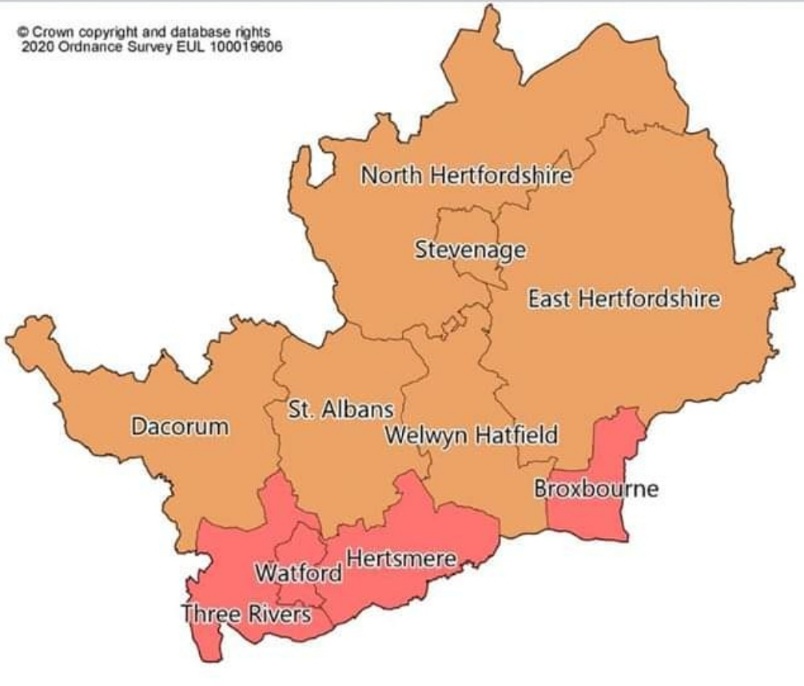
South Herts Tier 3 comes in on Wednesday Very High Alert
🚨 From 16 December, Tier 3 restrictions will apply to Watford.
The Mayor Peter Taylor insists we all pull together, play our part and bring the number of cases down so that we can see restrictions eased in the weeks and months ahead.
Hertsmere
Borehamwood, Bushey, Bushey Heath, Potters Bar, Radlett, Aldenham, Shenley, Letchmore Heath, South Mimms, Ridge, Patchett’s Green
Three Rivers
Rickmansworth, Abbots Langley, Leavesden, Croxley Green, South Oxhey, Chorleywood, Carpenders Park, Maple Cross & Mill End, Bedmond, Hunton Bridge, Sarratt, Moor Park and parts of Kings Langley and Nash Mills.
What you can and cannot do in an area in Tier 3 of local restrictions.
Meeting family and friends
Meeting indoors
You must not meet socially indoors with anybody you do not:
However, you can see friends and family you do not live with (or do not have a support bubble with) in some outdoor public places, in a group of up to 6. This limit of 6 includes children of any age.
These outdoor public places include:
parks, beaches, countryside accessible to the public, forests
public gardens (whether or not you pay to enter them)
allotments
the grounds of a heritage site
outdoor sports courts and facilities
playgrounds
You can continue to meet in a group larger than 6 if you are all from the same household or support bubble, or another legal exemption applies.
Support and childcare bubbles
There is separate guidance for support bubbles and childcare bubbles across all tiers. Support bubbles have been expanded. From 2 December you can form a support bubble with another household if you:
are the only adult in your household (any other members of the household having been under 18 on 12 June 2020), or are an under 18 year old living alone
live with someone with a disability who requires continuous care and there is no other adult living in the household
live with child under 1, or who was under 1 on 2 December 2020
live with a child under 5, or who was under 5 on 2 December 2020, with a disability
Meeting in larger groups
There are exceptions where people can continue to gather indoors or in private gardens, or in groups larger than 6, in outdoor public places:
for registered childcare, education or training – meaning education related to a formal curriculum or training that relates to work or obtaining work
for supervised activities provided for children and those who were under 18 on 31 August 2020, including wraparound care (before and after-school childcare), children’s groups, activities for under-18s, and children’s playgroups
for parent and toddler groups – up to a maximum of 15 people. Under-5s do not count towards this limit. These cannot take place in private dwellings.
for arrangements where children do not live in the same household as both their parents or guardians
to allow contact between birth parents and children in care, as well as between siblings in care
for prospective adopting parents to meet a child or children who may be placed with them
support groups of up to 15 participants – formally organised groups to provide mutual aid, therapy or any other form of support, where it is necessary for these to take place in person. These cannot take place in private dwellings. Under-5s do not count towards the 15 person limit for support groups
for birth partners
to provide emergency assistance, and to avoid injury or illness, or to escape a risk of harm
to see someone who is dying
to fulfil a legal obligation, such as attending court or jury service
for gatherings within criminal justice accomodation or immigration detention centres
for a wedding or equivalent ceremony where the organiser has carried out a risk assessment and taken all reasonable measures. Receptions are not permitted to limit the risk of transmission of the virus – up to 15 people. These cannot take place in private dwellings, except for weddings that take place in exceptional circumstances where one of the parties is seriously ill and not expected to recover.
for funerals – up to a maximum of 30 people – and for commemorative events, such as wakes or stonesettings – up to 15 people. These cannot take place in private dwellings
to visit someone at home who is dying, or to visit someone receiving treatment in a hospital, hospice or care home, or to accompany a family member or friend to a medical appointment
for elite sportspeople (and their support teams if necessary, or parents/guardians if they are under 18) to compete and train
for organised outdoor sport and physical activity and organised sports for disabled people
to facilitate a house move
Where a group includes someone covered by an exception (for example, someone who is working or volunteering), they are not generally counted as part of the gatherings limit. This means, for example, a tradesperson can go into a household without breaching the limit, if they are there for work, and the officiant at a wedding would not count towards the limit.
If you break the rules
The police can take action against you if you meet in larger groups. This includes breaking up illegal gatherings and issuing fines (fixed penalty notices).
You can be given a fixed penalty notice of £200 for the first offence, doubling for further offences up to a maximum of £6,400. If you hold, or are involved in holding, an illegal gathering of over 30 people, the police can issue fines of £10,000.
limit how many different people you see socially over any period of time
Protecting people more at risk from coronavirus
If you have any of the following health conditions, you may be clinically vulnerable, meaning you could be at higher risk of severe illness from coronavirus. If you are clinically vulnerable you:
can go outside as much as you like but you should still try to keep your overall social interactions low
can still go to school
should still access the social care and medical services you need
can visit businesses, such as supermarkets, pubs and shops, whilst keeping 2 metres away from others wherever possible or 1 metre plus other precautions, but consider doing so at quieter times of the day
should continue to wash your hands carefully and more frequently than usual and maintain thorough cleaning of frequently touched areas in your home and/or workspace
Clinically vulnerable people are those who are:
aged 70 or older (regardless of medical conditions)
under 70 with an underlying health condition listed below (that is, anyone instructed to get a flu jab each year on medical grounds):
chronic (long-term) mild to moderate respiratory diseases, such as asthma, chronic obstructive pulmonary disease (COPD), emphysema or bronchitis
chronic heart disease, such as heart failure
chronic kidney disease
chronic liver disease, such as hepatitis
chronic neurological conditions, such as Parkinson’s disease, motor neurone disease, multiple sclerosis (MS), or cerebral palsy
diabetes
a weakened immune system as the result of certain conditions or medicines they are taking (such as steroid tablets)
being seriously overweight (a body mass index (BMI) of 40 or above)
As well as specific exemptions set out below, any closed business can remain open for:
providing essential voluntary services or urgent public support services, including the provision of food banks or other support for the homeless or vulnerable people, blood donation sessions, support in an emergency
for the making of a film, television programme, audio programme or audio-visual advertisement
for the purpose of voting or related activities
Hospitality
Hospitality settings, such as bars (including shisha bars), pubs, cafes, restaurants, and social clubs must close except for takeaway, delivery and click and collect services. This includes restaurants and bars within hotels or member’s clubs. Exemptions apply for the following settings:
Cafes and canteens at:
hospitals, care homes, or supported housing as part of extra care schemes
schools and providers of post-16 education and training, such as further education colleges
higher education accommodation, and at higher education providers (where there is no practical alternative for staff and students to obtain food and where alcohol is not served for consumption on the premises)
criminal justice accommodation or immigration detention centres
naval/military/airforce or MoD facilities
workplace canteens (where there is no practical alternative and where alcohol is not served for consumption on the premises)
Services providing food or drink to those experiencing homelessness can also remain open.
Businesses and venues selling alcohol for consumption off the premises can continue to do so as long as this is through takeaway, delivery service, click-and-collect or drive-through
Food or alcohol purchased from a hospitality premises via takeaway or click-and-collect may not be consumed on any part of that premises, including beer gardens, as well as adjacent seating to the premises (with exceptions for motorway service areas, airports, seaports, the international terminal at Folkestone and public transport services although these places cannot sell alcohol after 11pm).
Businesses must not provide shared smoking equipment for use on the premises.
Accommodation
Accommodation such as hotels, B&Bs, campsites, holiday lets and guest houses must close. These premises can only open for a person, who:
is unable to return to their main residence
uses it as their main residence
needs it while moving house
needs it to attend a funeral, linked commemorative event or following a bereavement of a close family member or friend
is isolating themselves from others as required by law
is an elite athlete (or their coach) and needs it for training or competition
needs it for work purposes, or to provide voluntary or charitable service
was staying there immediately before the area entered Tier 3
needs it to attend education or training
is a carer for someone they live with and is seeking respite
needs to attend a medical appointment or treatment
They can also open:
to enable voting, including an overseas election
as a women’s refuge or a vulnerable person’s refuge
for any purpose requested by the Secretary of State, or a local authority
Businesses that remain open in law, but are located within accommodation, such as a spa within a hotel, can remain open.
These restrictions on accommodation do not apply between 22 to 28 December 2020. This means that accommodation may open during this period for people to stay in order to be located near their Christmas bubbles. However other restrictions, such as those on hospitality and social contact still apply – so people cannot mix with their Christmas bubble in a hotel, for example, unless a member of their bubble lives their permanently. Please see separate guidance for more information on the rules for social contact during the Christmas period (23 to 27 December).