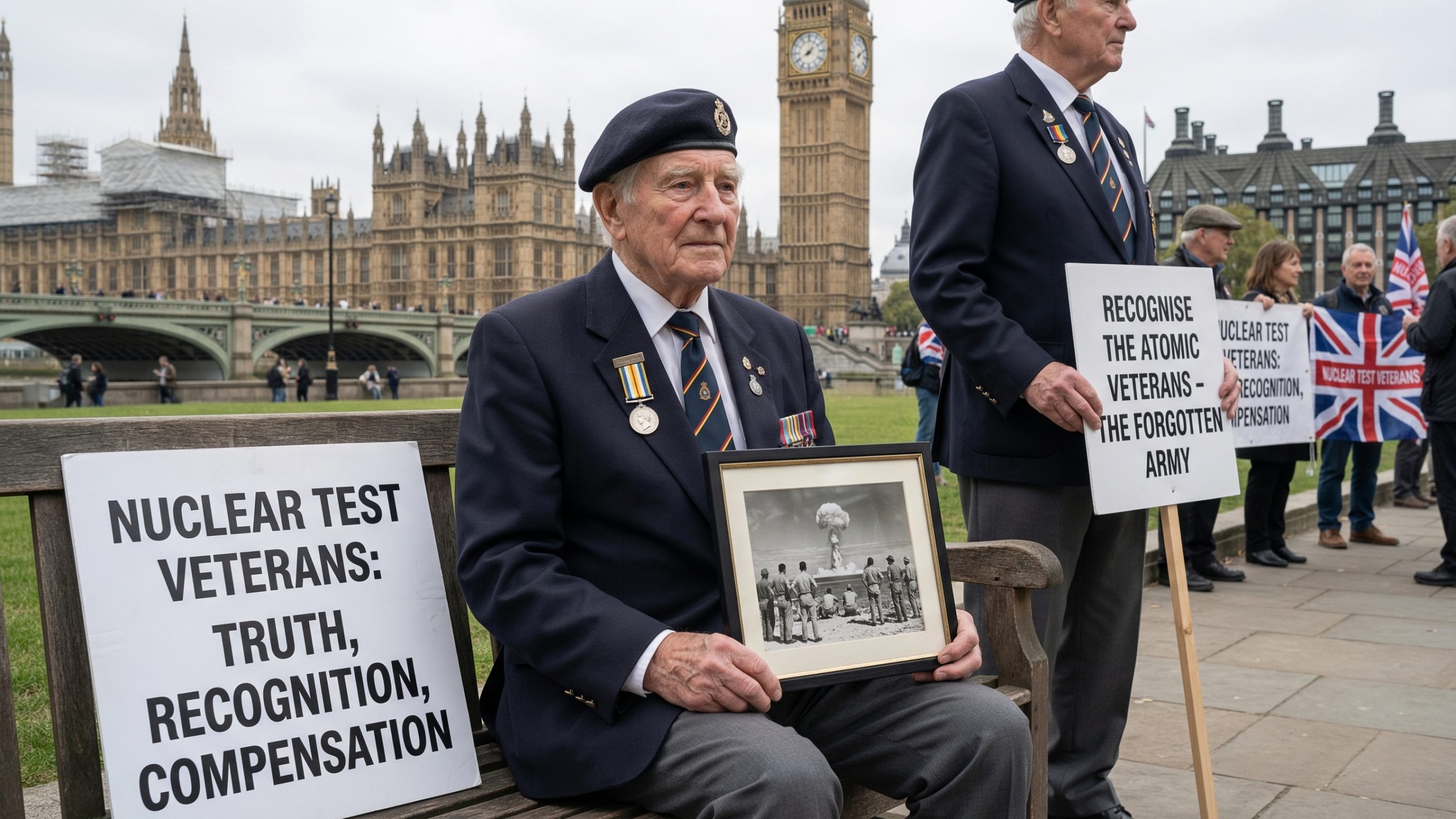
Nuclear Test Veterans Win Landmark Inquiry — Now Comes the Fight for a Memorial and Payouts
Following a dramatic BBC Newsnight special and a Downing Street breakthrough, Prime Minister Andy Burnham has ordered a Hillsborough-style probe into Britain’s Cold War atomic tests. With surviving veterans now in their late eighties, campaigners say securing a permanent memorial and financial compensation cannot wait years.
For more than four decades, the British servicemen who witnessed nuclear detonations in Australia and the South Pacific between 1952 and 1967 have fought a relentless battle for accountability. Last night’s BBC Newsnight special brought that struggle squarely into the national spotlight—and marked a watershed moment for thousands of veterans and their families.
Hosting campaigners at 10 Downing Street before the broadcast, Prime Minister Andy Burnham announced the creation of a fully independent panel to investigate the health impacts of the Cold War testing programme and decades of alleged official concealment. Chaired by Bishop James Jones—the former Bishop of Liverpool who led the Hillsborough Independent Panel—the inquiry has been stripped away from the Ministry of Defence (MoD) and will operate under the legal duty of candour introduced by the Hillsborough Law.
Mr Burnham pulled no punches over what veterans have long alleged regarding missing blood and radiation monitoring files, describing the decades-long withholding of records as a “criminal cover-up on an industrial scale”. For Alan Owen, co-founder of the campaign group Labrats, taking the investigation out of the MoD’s hands represents a “fantastic step forward” after years of institutional stonewalling.
What Campaigners Are Fighting For
While the inquiry opens the door to the truth, veteran groups insist that uncovering hidden files is only the first step. Their demands centre on four key pillars:
- Full Disclosure of Medical Records: Unfettered access to the blood, urine, and biological monitoring tests taken from troops during the trials, ending decades of denials over whether those files existed.
- A Prominent National Memorial: A permanent, high-profile monument in London to honour the estimated 22,000 British personnel who served in the atomic tests and the families who have lived with the consequences.
- Fair Financial Compensation: A dedicated compensation scheme for surviving veterans and bereaved families—bringing Britain into line with the United States, France, Canada, and Australia, all of which have paid reparations to their own atomic test veterans.
- Research Into Intergenerational Health: State-backed medical research into rare cancers, blood disorders, and genetic conditions suffered not only by the veterans themselves, but by their children and grandchildren.
The Next Steps: Getting a Memorial and Payouts
With around 1,200 test veterans still alive and their average age now 88, campaigners warn that justice delayed will be justice denied. Turning yesterday’s Downing Street promise into tangible action requires movement on two separate fronts:
1. Fast-Tracking the National Memorial Unlike financial payouts, a national memorial does not need to wait for an inquiry to conclude. Now that the government has formally backed the principle of truth and recognition, campaigners will push ministers to begin immediate consultations with veteran groups on a central London site, design, and state funding so that surviving veterans can see it unveiled in their lifetime.
2. Breaking the Compensation Deadlock Winning financial payouts remains the biggest hurdle. Appearing alongside veterans and families on Newsnight, Defence Secretary Wes Streeting refused to rule out a formal apology or compensation, stating that ministers would not prejudge the panel but must “follow where the facts take them”.
Currently, sick veterans are forced to apply through the standard War Pension Scheme, where the burden of proof lies heavily on the claimant to link an illness to radiation exposure more than 60 years ago—a near-impossible task when medical records were withheld. Once Bishop Jones’s panel delivers its interim report—targeted for 3 October 2027, the 75th anniversary of Britain’s first nuclear test—campaigners will press the government to bypass drawn-out court battles and establish a bespoke statutory compensation scheme.
For the ageing men who stood on the beaches of Christmas Island and the deserts of Maralinga, the wall of silence in Whitehall has finally cracked. Whether Westminster moves fast enough to deliver a memorial and financial justice while they are still here to see it will be the true measure of this historic breakthrough.
Britain stands almost alone among Western allied nations involved in Cold War atomic testing in refusing to establish a dedicated compensation scheme for its nuclear test veterans. Under the United States’ Radiation Exposure Compensation Act (RECA) and Department of Veterans Affairs rules, American atomic veterans who develop dozens of recognised cancers receive automatic, “presumptive” lump-sum payouts—recently expanded to $100,000—without having to prove their illness was directly caused by radiation. Similarly, France established a statutory compensation fund in 2009 for military personnel and civilians sickened by its tests in Algeria and French Polynesia, while both Canada and Australia have provided dedicated financial settlements and automatic healthcare coverage for their exposed personnel. By contrast, British veterans have had to rely on the standard War Pension Scheme, which places the burden of proof on elderly claimants to demonstrate a direct causal link to radiation more than six decades ago—a near-impossible hurdle when vital medical records remain missing.


