The Digital Strip Search: Why UK Police Forces Are Pouring Millions into Spyware Linked to Global Rights Abuses
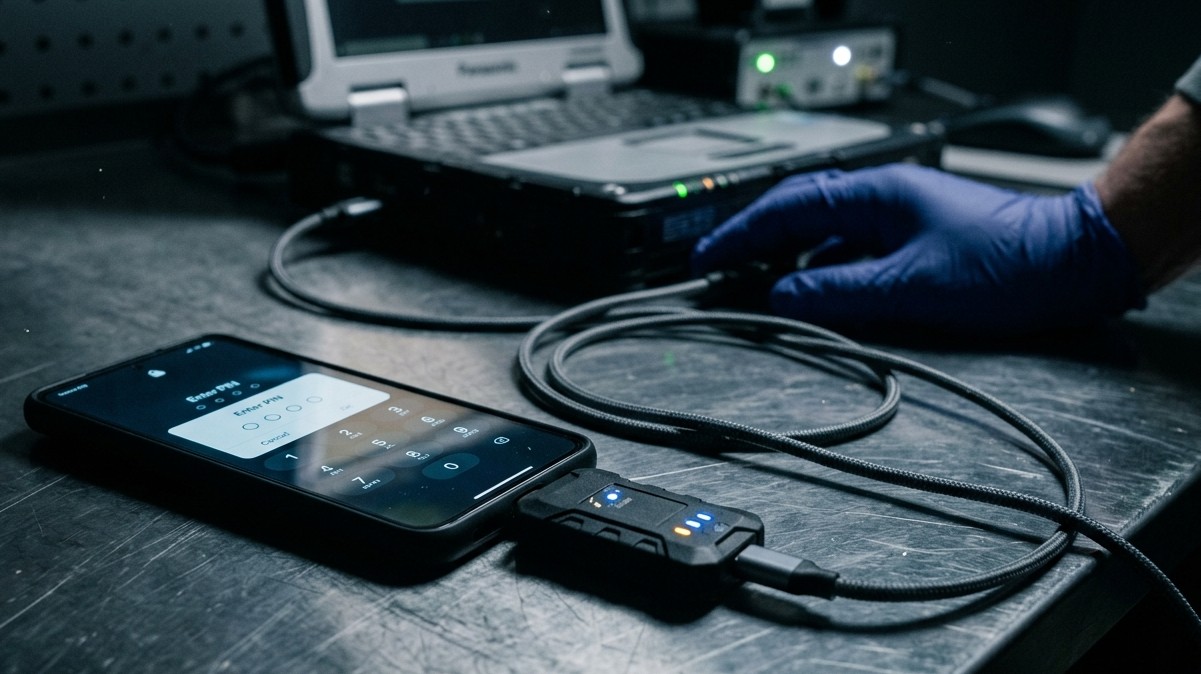
In the United Kingdom, the legal boundary protecting a citizen’s home is ancient and ironclad. If law enforcement wishes to cross your threshold, search your drawers, or read your private diary, they must typically present a warrant signed by a magistrate. Yet, an extraordinary legal and technological loophole has quietly emerged on British streets. Today, local police forces can bypass the lock on your smartphone, copying a bit-by-bit replica of your entire digital existence—your location history, deleted text messages, private photographs, and encrypted chats [cellebrite.com].
Privacy advocates call this process a “digital strip search” [bigbrotherwatch.org.uk]. To perform it, British law enforcement relies heavily on highly intrusive forensic software manufactured by Cellebrite, an Israeli digital intelligence firm.
While marketed at home as standard tools for modern policing, Cellebrite’s technology carries a heavy global reputation. International human rights watchdogs, including Amnesty International and The Citizen Lab, have repeatedly documented the company’s software being weaponised by authoritarian regimes to track, prosecute, and imprison political dissidents, journalists, and activists in countries ranging from Jordan to Serbia.
Amnesty International published a scathing report detailing how Serbian police and intelligence units routinely misused Cellebrite equipment outside legally sanctioned processes to spy on civil society and independent journalists. The fallout forced Cellebrite to formally halt product use for specific customers in Serbia.
Despite these stark ethical warnings, public procurement data reveals that British taxpayers are actively funding the expansion of this surveillance network. High-profile forces like London’s Metropolitan Police Service (MPS) and Hertfordshire Constabulary have embedded Cellebrite tools into the core of their digital forensic operations [london.gov.uk].
The Local Ledger: Millions in Public Contracts
The financial trail tying local UK policing to this controversial technology is out in the open. Public records from the Mayor’s Office for Policing and Crime (MOPAC) confirm that the Metropolitan Police signed massive multi-million-pound equipment refresh contracts explicitly prioritizing Cellebrite technology [london.gov.uk].
Simultaneously, Hertfordshire Constabulary has been named among the regional forces trialling Cellebrite’s latest algorithmic systems [policeprofessional.com]. This procurement occurred despite explicit written evidence submitted to the UK Parliament warning that the Met’s deep reliance on Cellebrite risked directly “undermining public trust in policing.” [committees.parliament.uk]
This creates a glaring moral contradiction for British policing. A landmark study published in the British Journal of Criminology directly critiqued the UK state for ignoring what academics term “moral taint” in its technology procurement. The paper highlights a troubling reality: British police forces are actively utilizing the exact same technological capabilities that have facilitated human rights abuses and state-sponsored crackdowns against civil society abroad [oup.com].
Public contract registries show substantial payouts across the country, including a £328,000 renewal by Leicestershire Police, alongside ongoing licensing agreements with Kent and Essex Police, Bedfordshire Police, and North Wales Police.
The Corporate Shroud of Secrecy
What makes this rapid expansion of digital surveillance particularly concerning is the wall of silence surrounding its implementation. When The Guardian investigated the early deployment of these automated systems, it revealed a troubling structural barrier: Cellebrite routinely employs strict commercial non-disclosure agreements (NDAs) [theguardian.com]. This means that while public money changes hands, the full list of regional UK constabularies utilizing these invasive techniques remains heavily shielded from public scrutiny.
For transparency advocates, this corporate shroud is a dangerous subversion of democratic policing. If a local force like Hertfordshire Constabulary or the Metropolitan Police deploys an algorithm to sift through a citizen’s private files, the public has a fundamental right to know how that software operates, what its error rates are, and exactly how their data is being handled. Instead, accountability is sacrificed at the altar of proprietary trade secrets.
Bypassing the Lock: The Power of ‘Inseyets’
The latest weapon in this digital arsenal is Cellebrite’s flagship suite, Inseyets. Designed to smash through the updated security features of modern Apple and Android operating systems, Inseyets closes what the company calls the “access gap.”
Rather than merely dumping raw data onto a screen, this new software applies advanced machine learning and automation. It maps social networks, builds automated timelines of a suspect’s movements, and employs AI-driven triaging to automatically flag specific faces, keywords, or patterns.
The danger to ordinary British citizens is structural. When an individual is arrested, police often demand their phone PIN under the threat of prosecution under the Regulation of Investigatory Powers Act (RIPA) [thblegal.com]. But if a citizen refuses, tools like Inseyets frequently allow police to break into the device anyway. The friction required to access a person’s entire digital life has effectively been erased, replaced by an automated process that turns every seized phone into an open book.
The Path Ahead: A Demand for Transparency
As technologies like Cellebrite Inseyets become faster, more automated, and deeply reliant on machine learning, the UK stands at a critical crossroads [cellebrite.com]. Police forces cannot continue to operate under a dual standard—demanding total digital transparency from the citizens they arrest under threat of imprisonment, while hiding their own technological capabilities behind a wall of corporate NDAs.
If British policing is to maintain its historic foundation of consent, the digital frontier must be dragged into the light. Until local authorities face stringent, independent oversight regarding their tech procurement, every smartphone in the country remains just one police interaction away from a borderless, automated digital strip search.
The UK state is using public taxpayer money to buy into a technology loop that is fundamentally uncontrollable.
Even if Cellebrite claims it obeys international sanctions, forensic evidence proves that its code routinely slips into the hands of abusive regimes to carry out illegal, politically motivated crackdowns. By funding the development of tools like Inseyets, the UK public sector is directly subsidising a global surveillance architecture that watchdogs argue places dissidents, journalists, and everyday privacy at severe risk.


